

Importing and Exporting
A document tool is only as useful as the work you can get into it and the deliverable you can get out. This guide teaches how to bring an existing file into Backbuild Docs, how to produce every format a reader or a submission asks for, and how to return to any earlier draft with version history. After it you will be able to open a Word file you were sent, hand back a Word file or a PDF, publish to Markdown or HTML, and recover an earlier version without hunting for the right attachment. It is honest about where a conversion is lossy and why, so you can plan around it rather than be surprised by it.
Importing: What Comes In
After this section you will get an existing document into the editor, whatever tool it came from. Open an import from the File menu and choose the file. Backbuild Docs reads the file by its actual content, not by the extension on its name, so a file that was renamed still imports correctly. The supported formats are:
- Microsoft Word (the modern
.docxformat), including a document exported from Google Docs, which exports as.docx. - OpenDocument Text (
.odt), the format LibreOffice and OpenOffice write. - Legacy Word (the
.docformat from Word 97 to 2003). Its text and paragraphs come in; a legacy.docis a good way to rescue an old file rather than a full-fidelity design import. - Rich Text Format (
.rtf). - HTML, so you can bring in a web page or an exported web document.
- Markdown, so notes and docs-as-code content come straight in.
An import replaces the content of the document you have open with the imported file, so import into a new, empty document; if you import over a draft by mistake, look in version history for an earlier version to restore. The import is then a normal Backbuild Docs document you edit, format, and share like any other. Headings, lists, tables, and inline formatting come across; the document arrives with real structure, so you can immediately apply a named style or reflow it rather than untangling ad-hoc formatting.
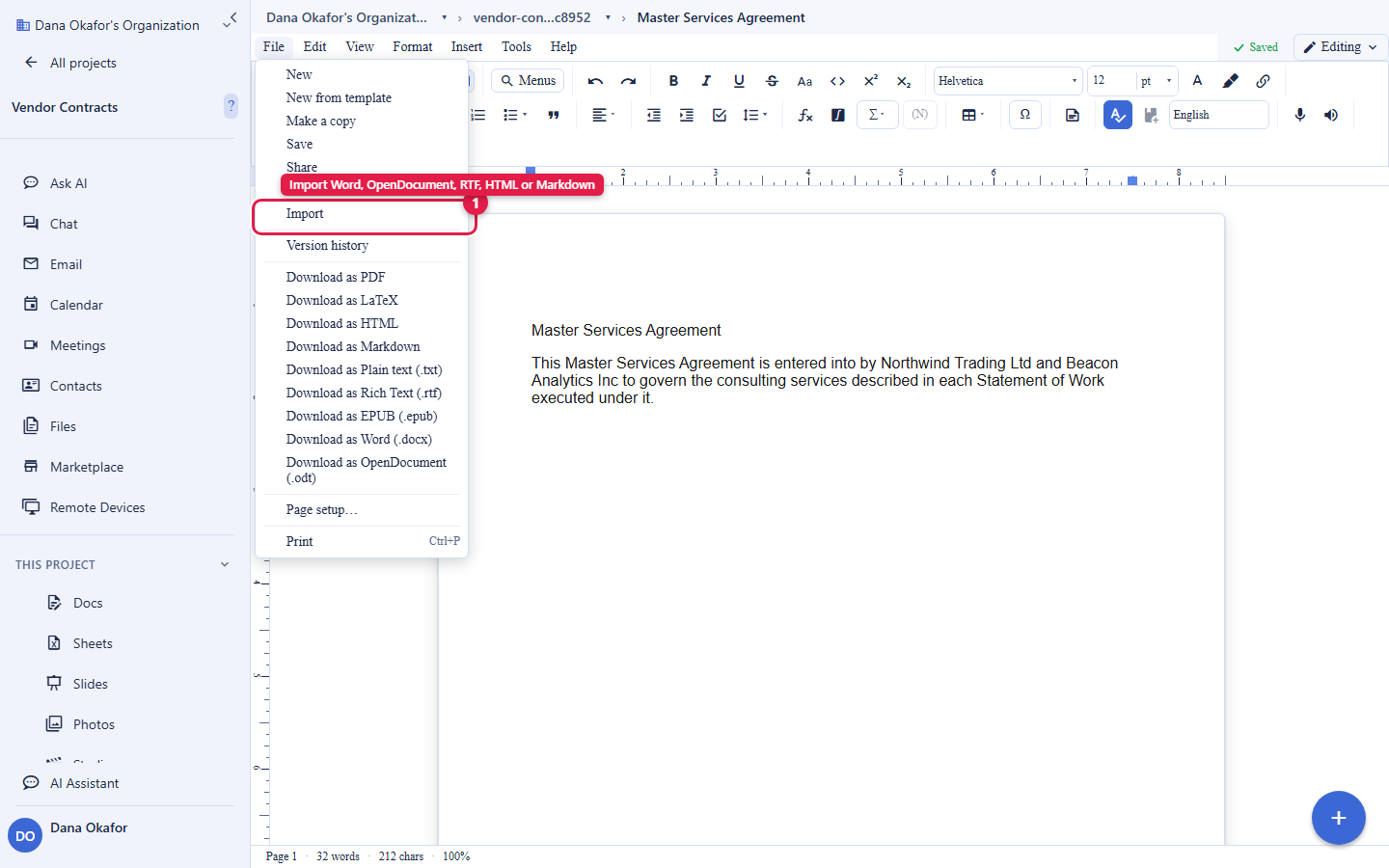
Will it import my existing Word or Google Docs file cleanly?
Yes. Import a Word .docx file directly; a Google Docs document exports
as .docx, so it comes in the same way. Headings, lists, tables, and
inline formatting are preserved, and the document arrives with real underlying
structure rather than a flattened copy. Very heavy or unusual layout can shift, so
check a complex file after import, but everyday documents come across faithfully.
Does it import by file extension or by content? By content. The importer inspects the file itself and handles it as what it actually is, so a mislabeled or renamed file still imports correctly.
Exporting: What Goes Out
After this section you will produce the exact deliverable a reader or a submission needs. From the File menu you can download the document in a range of formats, so nothing is trapped in a proprietary shape:
| Format | Use it for |
|---|---|
Microsoft Word (.docx) | Handing the text of a document to someone who works in Word, such as a clean copy for a counterparty. Check the notes below for what Word does not receive. |
| A fixed, final deliverable with your images, equations, and layout. Produce it with File then Print and save as PDF; what you see in the editor is what prints. The Download as PDF item in the File menu is not available yet. | |
OpenDocument Text (.odt) | A reader who uses LibreOffice or OpenOffice. |
| HTML | Publishing to the web or pasting into a content system. |
| Markdown | Docs-as-code pipelines and version-controlled documentation. |
Rich Text Format (.rtf) | A widely compatible interchange format. |
| EPUB | A reflowable e-book for long-form reading. |
| Plain text | The words alone, with no formatting. |
LaTeX source (.tex) | A journal or preprint pipeline that compiles the source to PDF. Download as LaTeX is available on the Backbuild Lite, Pro, and Enterprise plans, or with Backbuild Prove or Backbuild Science. |
Tables travel into every format that has them. Images travel fully only into a printed PDF, and equations into a printed PDF and the LaTeX download: Word and OpenDocument receive a placeholder for each image and the LaTeX source of each equation, and the formats below say exactly what each one carries. See Images, Tables, Math, and Citations for how those objects behave in the editor.
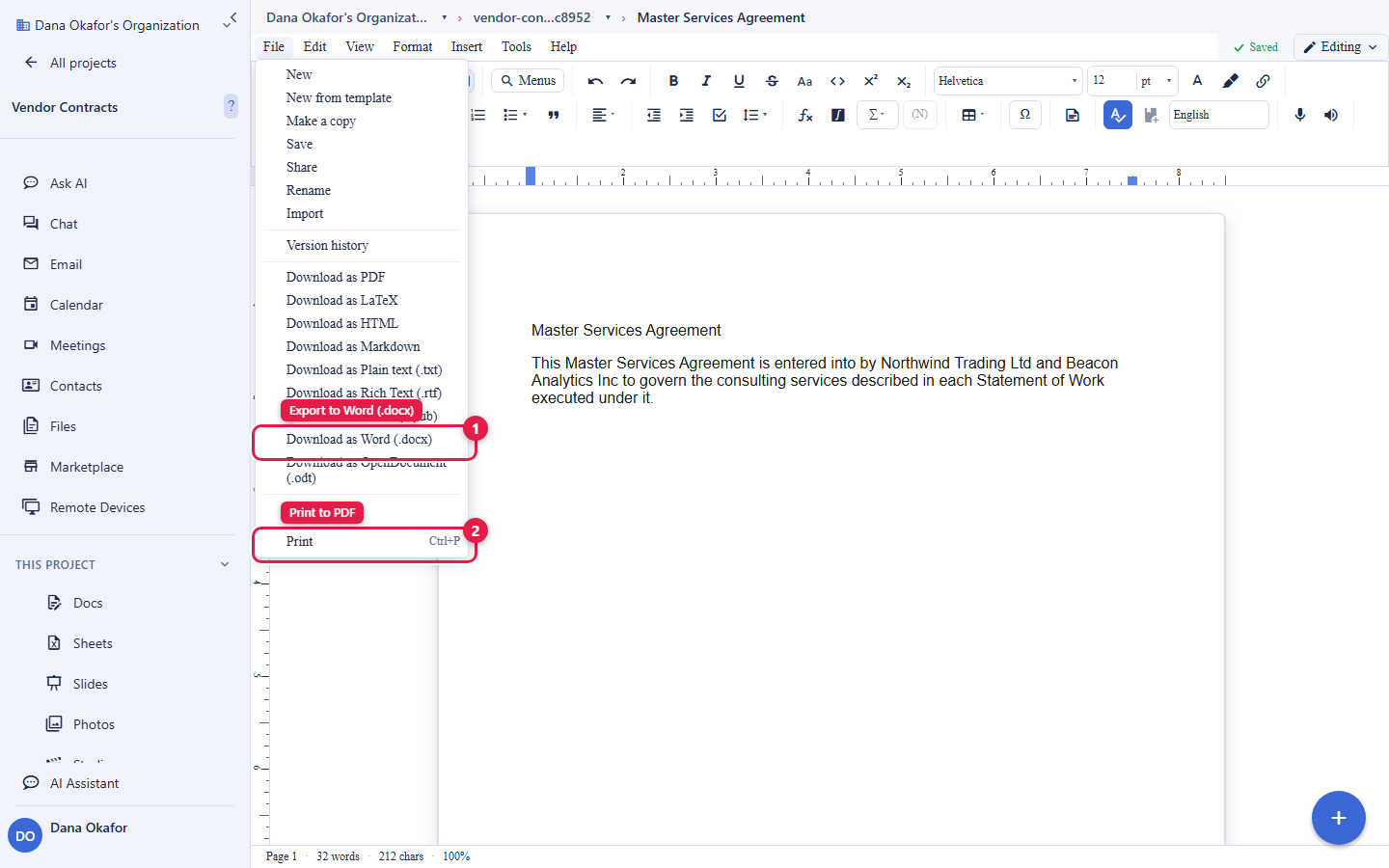
Can I export back to Word and PDF without losing my formatting? PDF, yes: print to PDF and it matches what you see, images, equations, and layout included. Word keeps your headings, paragraph alignment, character formatting, links, single-level lists, and tables, but not your images, rendered equations, nested list levels, own named styles, or page setup; the notes below list each one. When the counterparty needs the full look, send the PDF alongside the Word file.
How do I get a PDF? Use File then Print and save as PDF through your browser or system print dialog. There is no separate compile step; the document is already rendered, so printing it is instant. The Download as PDF item in the File menu is not available yet.
What Survives, and Where a Conversion Is Lossy
After this section you will know what to check after a conversion. Every conversion between two document formats trades something, because no two formats model a document identically. Plan around these boundaries:
- Word and OpenDocument carry headings (levels 1 to 6), paragraphs and their alignment, character formatting (bold, italic, underline, strikethrough, superscript and subscript, text color, highlight, font, and size), links, tables, quotes, and code blocks. Lists keep one level: a nested list comes out flattened. Each image becomes a bracketed placeholder with the image's description, each equation is written as its LaTeX source text, and page breaks, section breaks, columns, and other layout elements are written as their LaTeX source in a code-formatted paragraph. Your own named styles are not carried; headings use the standard heading styles. A Word file always uses US Letter pages with one-inch margins, and an OpenDocument file uses the receiving program's default page, whatever your Page Setup says.
- Tracked changes are not represented in a Word or OpenDocument export: the inserted text and the deleted text both come out as ordinary text. Accept or reject every suggestion before you export, or send a printed PDF of the marked-up document. Redlining is covered in Tracked Changes.
- HTML carries the text, headings, lists, tables, and links. Each image comes out as an image tag with its description but without the picture, and each equation as its LaTeX source, ready for a math renderer on the page you publish to.
- Markdown and plain text are intentionally simple formats. Headings, lists, links, and basic emphasis come out cleanly; an image in Markdown points at an address that only Backbuild understands, so re-link it where you publish; rich page layout (columns, precise margins, headers and footers) has no Markdown equivalent. Use Markdown for content, not for print layout.
- LaTeX source is the document's own format, so structure, equations, and tracked changes are all in it. The download is the single source file: images are referenced by file name and are not included in it.
- Legacy Word (
.doc) import brings in text and paragraphs; it is a rescue path for an old file rather than a design-preserving import. - Custom tab-stop positions are a display convenience of the live document and are not preserved through a LaTeX round-trip; use a table where alignment must survive every export.
The point of stating this plainly is that you can choose the right export for the job. For an editable hand-off of the text, use Word or OpenDocument; for the web, use HTML; for a fixed final copy with every image and equation, print to PDF; for a journal submission, download the LaTeX source.
| Content | Word, OpenDocument | PDF (Print) | HTML | Markdown |
|---|---|---|---|---|
| Headings and character formatting | Yes | Yes | Yes | Headings and basic emphasis |
| Lists | One level | Yes | Yes | Yes |
| Tables | Yes | Yes | Yes | Yes |
| Images | Placeholder | Yes | Description only | Re-link needed |
| Equations | LaTeX source | Yes | LaTeX source | LaTeX source |
| Page setup and columns | No | Yes | No | No |
| Tracked changes | No: accept or reject first | As shown on screen | No | No |
Version History: Never Lose a Draft
After this section you will return to any earlier state of a document without keeping a pile of files. Because everyone works on one live copy, Backbuild Docs keeps a history of that copy for you. From the File menu you can:
- See the versions of a document as a timeline of saved states.
- Open a version to read exactly what the document looked like at that point.
- Restore a version to bring an earlier state back as the current document, without losing the later history. The restore is added to the timeline as a new version, and the restored content appears at once for everyone who has the document open.
The history is a record you can rely on. Saved versions are append-only: once a version is recorded, no person, integration, or AI agent in your workspace can change its content or delete it (you can give a version a name), and a restore adds to the history rather than rewriting it. Versions go away only when the document itself is permanently deleted, or when personal data in it must be erased on request.
This is what ends the "which file is the current one" problem. There is no Contract_v3_FINAL_final.docx to guess at and no manual draft to shuffle over email: there is one document, and its history is inside it. Produce a clean copy from a redline and you can still return to the marked-up state; restore a draft you thought was gone and pick up where it was.
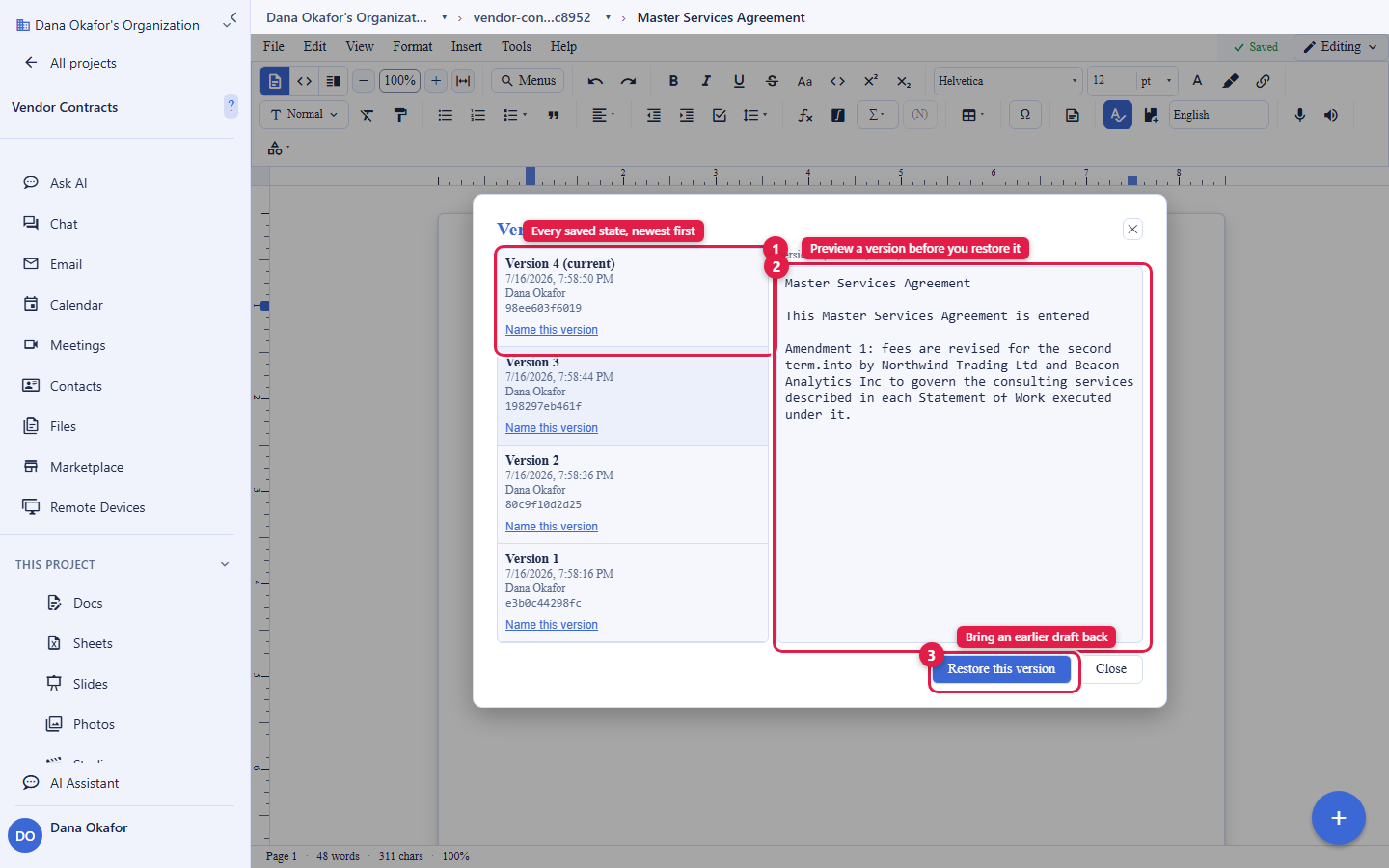
How do I stop working from the wrong draft and always know which is current? There is only ever one live document, so there is no "current draft" to track down. If you need an earlier state, open version history, preview the version you want, and restore it. No version is ever overwritten, and no file-naming convention is holding your process together.
Is version history free? Yes. Version history, like real-time co-authoring and tracked changes, is part of Backbuild Docs on every plan. See the pricing page for current allowances.
Where to Go Next
- Suggesting, Tracked Changes, Compare, and Combine: produce a redline copy and a clean copy for export.
- Images, Tables, Math, and Citations: how each object travels into an export format.
- AI Assistance, the API, and Agents: automate document creation and export from code and from agents.